In pharmaceutical cleanrooms, sensors must do more than measure precisely. They need to deliver stable readings over long periods, withstand repeated cleaning and decontamination cycles, and remain reliable even when exposed to H₂O₂. This is exactly what matters in laminar airflow monitoring. The EE680 was developed for these requirements, featuring a long-term stable sensing element, a cleanroom-suitable design, and protection against H₂O₂ sterilisation.
Why Long-Term Stability and Reliable Protection Mechanisms Matter in Cleanrooms
In pharmaceutical environments, a good reading at commissioning is not enough. Especially in laminar flow applications, safety cabinets, cleanroom modules, or beneath filter fan units, air velocity must be measured accurately over the long term. Even small deviations can make it more difficult to assess airflow conditions, compromise process reliability, or create additional effort in qualification, maintenance, and documentation.
For operators and equipment manufacturers, not only accuracy and response time matter, but also long-term stability. Sensors must perform reliably in continuous operation and continue to provide traceable measurement values even after extended service life. In laminar flow applications, this is not a convenience feature but a key requirement for stable processes and regulatory confidence.
Regular cleaning and decontamination cycles also play an important role, often involving alcohol-based media or H₂O₂. Over time, these substances can attack materials, connections, and sensitive sensing elements. What matters, therefore, is sensor technology that is chemically resistant and maintains its measurement performance even under these conditions.
E+E Elektronik’s Solution: The EE680
The EE680 is designed precisely for such applications. It measures air velocity and temperature in laminar airflows, operates according to the hot-film anemometer principle, and delivers highly accurate readings from as low as 0.1 m/s. Factory multi-point adjustment ensures excellent measurement performance across the entire operating range. At the same time, a proprietary hermetic polymer coating protects the sensing element against H₂O₂ sterilisation and other aggressive cleaning agents.
Long-Term Test of the EE680: Stable Readings in During Continuous Operation
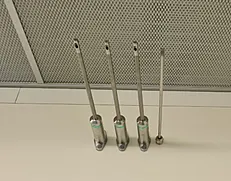
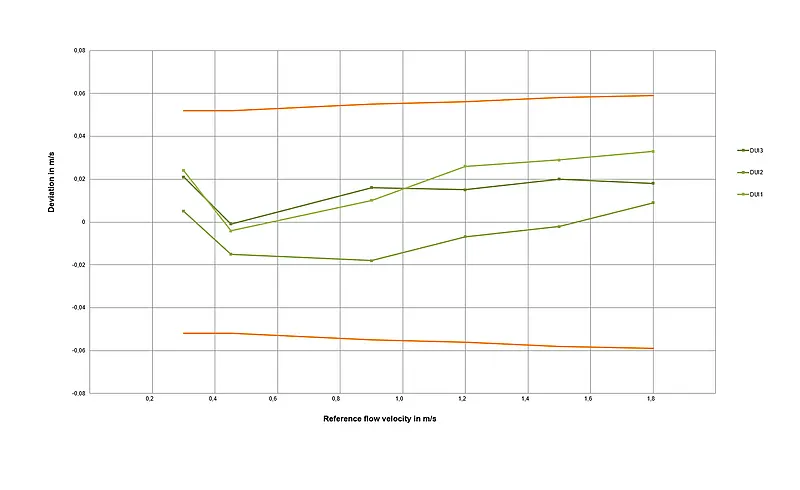
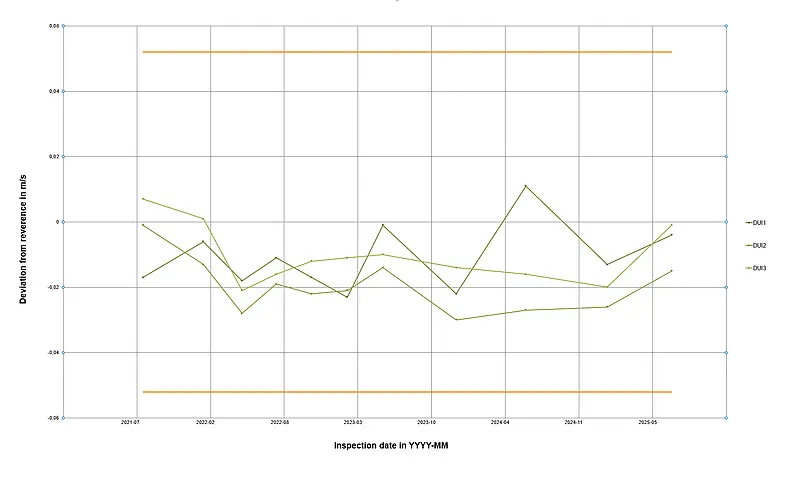
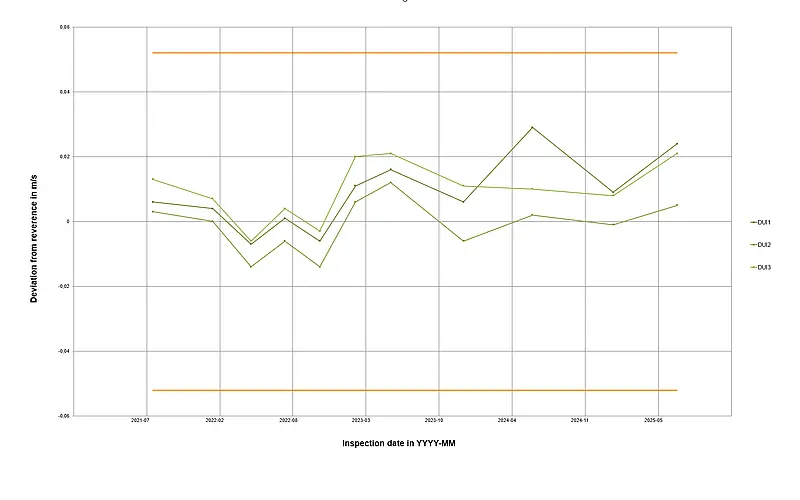
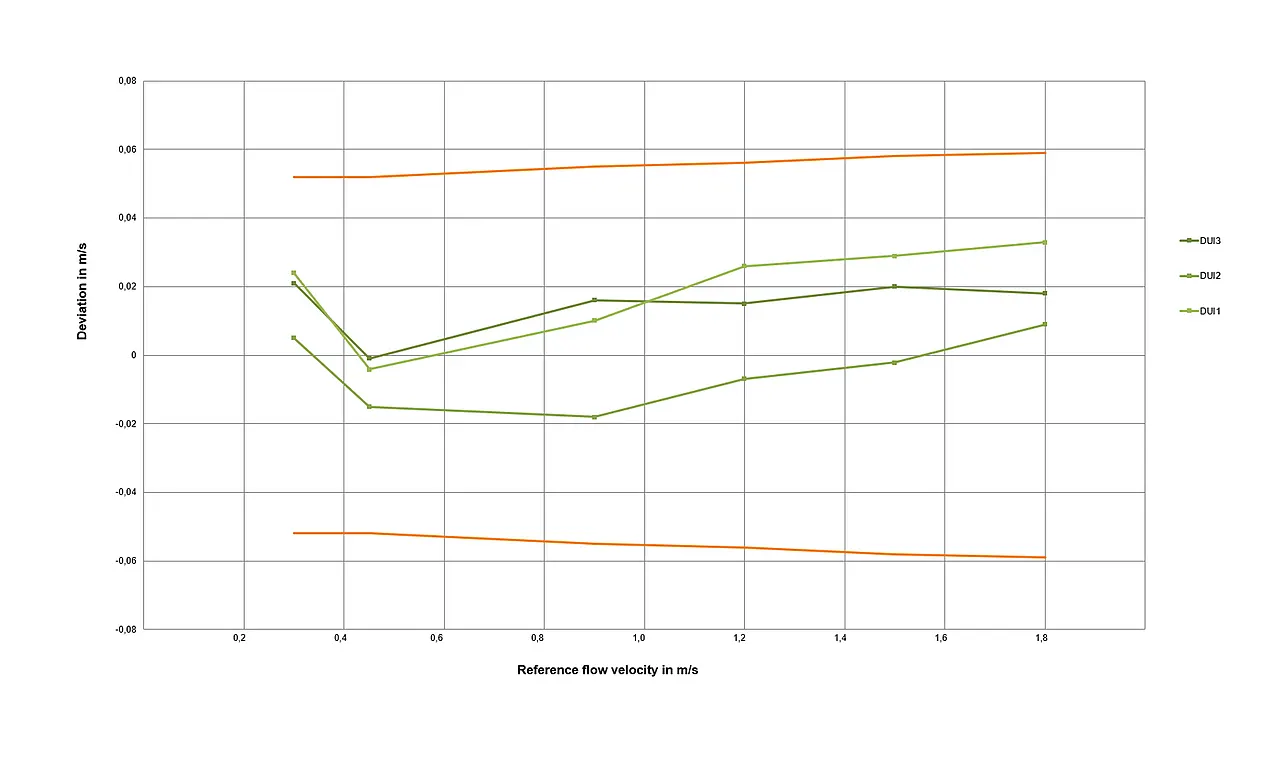
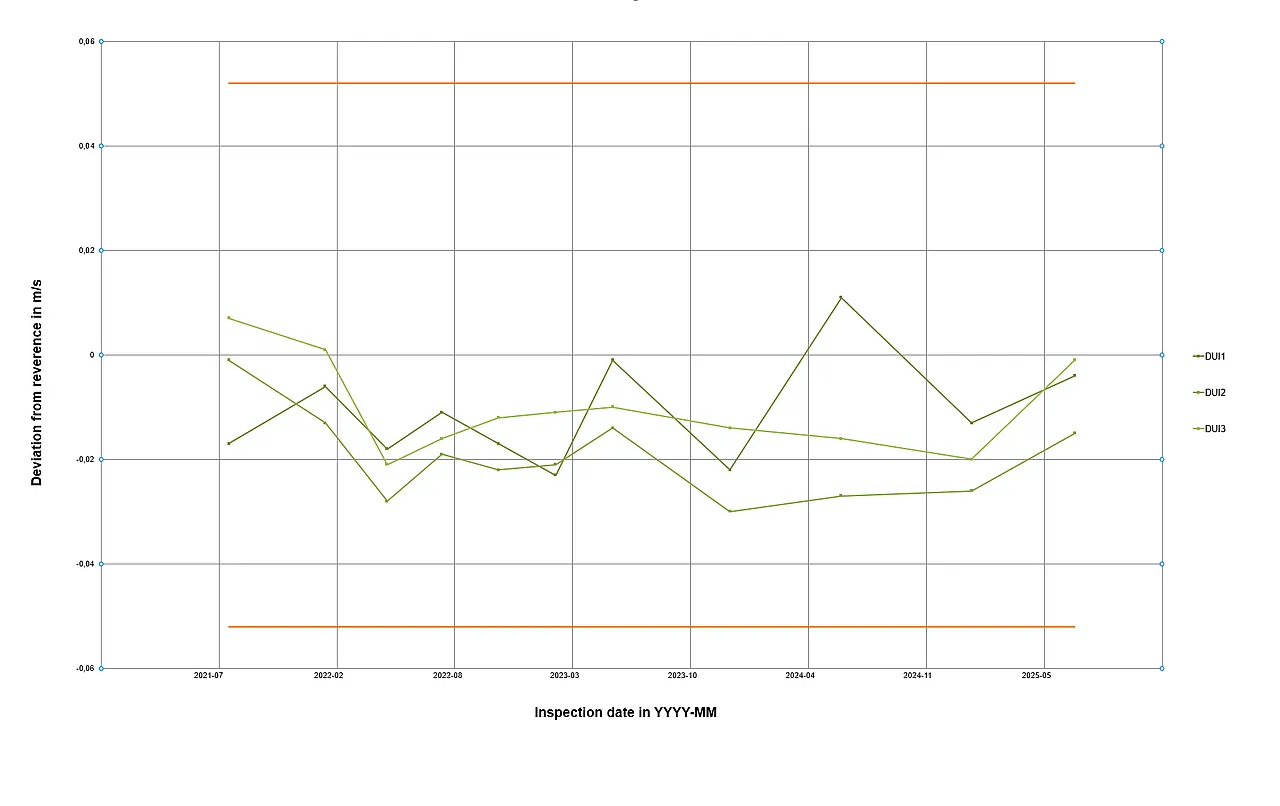
How robust the EE680 is in real-world use is demonstrated by a long-term test under realistic conditions. Three EE680 units were installed and operated in a cleanroom underneath a filter fan unit. The devices were regularly checked against a production reference, initially every quarter, and later every six months. The final characterisation gives a clear picture: deviations remained stable and non-critical across the relevant operating range.
Figure 1: Installation of the test specimens underneath an FFU
Stable Results in Relevant Application Zones
Particularly meaningful are the verification points at 0.30 m/s and 0.45 m/s. This is exactly the range in which many pharmaceutical laminar flow applications operate. Over the entire observation period, the EE680 showed stable behaviour with no noticeable drift. For users, this means greater confidence in day-to-day operation and less risk of measurement values gradually changing without being detected immediately.
2,000 Hours of H₂O₂ Exposure: No Noticeable Changes
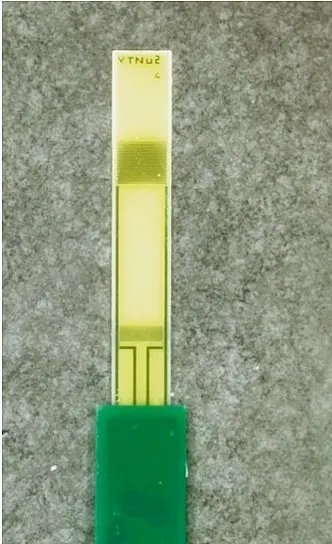
In addition to its long-term behaviour in a cleanroom operation, the H₂O₂ resistance of the sensing element was also specifically tested. For this purpose, 15 sensing elements of the type used in the EE680 were operated for 2,000 hours in an atmosphere containing 35% H₂O₂. Throughout the test, the electrical properties were continuously monitored, and the optical condition was assessed at the end.
The result is clear. The electrical properties of the sensing elements remained virtually unchanged at the start, after an interim check at 1,000 hours, and after the final tests at 2,000 hours. The optical inspection also revealed no visible damage over the full 2,000-hour period. The test therefore confirms that the sensing elements remain within the normal range even under prolonged H₂O₂ exposure.
What This Means for Cleanrooms and Pharmaceutical Machinery
For pharmaceutical applications, this is a real advantage. Anyone monitoring laminar airflows needs sensors that continue to measure reliably even after repeated decontamination cycles and in continuous operation. This is exactly where the EE680 shows its strength. The combination of long-term stability, H₂O₂ resistance, and precise measurement of very low air velocities reduces uncertainty in operation and supports stable process control.
This is particularly relevant for laminar flow hoods, safety cabinets, isolators, RABS, and cleanroom modules with continuous monitoring. In these environments, it is not short-term good readings that count, but robust sensor technology that remains reliable over the long term and reduces the effort required for verification, maintenance, or unplanned sensor replacement.
Conclusion
The EE680 is built for the demands of pharmaceutical cleanrooms. It measures very low air velocities with precision, remains long-term stable in continuous operation, and withstands H₂O₂ even under severe long-term exposure. The available test data therefore show exactly what matters in practice: reliable laminar flow monitoring, even where cleaning and decontamination cycles are part of everyday operation.
For operators, integrators, and equipment manufacturers, this means greater confidence during system design, more trust in the measurement values, and a sensor solution developed specifically for demanding cleanroom conditions.
This website uses cookies
We use cookies and tracking technologies (including those from third parties) to optimise our website and integrate features such as Google Maps and YouTube.
Your data may be transferred to the USA, where a lower level of data protection compared to the EU applies. Therefore, data transfer will only occur with your explicit consent.
Please choose in the cookie settings which cookies you wish to allow. Non-essential cookies will only be set with your consent. Without your consent, some features of the website may be restricted.
You can withdraw your consent at any time in the cookie settings. For more information, please refer to our Privacy Policy.
Your data protection settings
Enable and disable individual cookies. Required cookies cannot be disabled.
This is a Microsoft cookie that contains a GUID assigned to your browser. It gets set when you interact with a Microsoft property, including a UET beacon call or a visit to a Microsoft property through the browser.
Expires after
12 months
Cookie Name
_uetsid
Purpose
This contains the session ID for a unique session on the site. Note: As of as of July 2023, _uetsid has been updated with additional parameters as follows: insights_sessionId, timestamp, pagenumber, upgrade, upload.
Expires after
30 minutes
Cookie Name
_uetvid
Purpose
UET assigns this unique, pseudoanonymized visitor ID, representing a unique visitor. UET stores this data in a first-party cookie. Note: As of as of July 2023, _uetvid has been updated with additional parameters as follows: insights_userId, cookieVersion, expiryTime, consent, cookie_creation_time.
Expires after
12 months
Cookie Name
_RwBf
Purpose
This cookie helps to track the effectiveness of advertising campaigns on the Bing advertising network.
Expires after
6 months
Cookie Name
_uetmsclkid
Purpose
This is the Microsoft Click ID, which is used to improve the accuracy of conversion tracking.
Expires after
6 months
Cookie Name
MSPTC
Purpose
UET assigns this unique, pseudoanonymized visitor ID, representing a unique visitor. It's a partition cookie. This cookie is used in the browsers' Privacy API.
Expires after
6 months
Cookie Name
MR
Purpose
This is a Microsoft cookie that contains a binary flag. It gets set when you interact with a Microsoft property, including a UET beacon call or a visit to a Microsoft property through the browser.